Key (online version)
|
|
1a |
| Wings normally developed. |
|
2 |
| b |
| Wings reduced to a minute vestigial lobe, halteres present. Whole surface of first abdominal tergite of male with a distinctive granulated ommatidia-like pattern. |
| Thripomorpha paludicola (Enderlein, 1905) |
|
|
| |
|
2a |
| Scutum with an elevated U-shaped ridge [Fig. 749]. Anterior tibia with a strongly developed apical spur. Costa strongly swollen at junction with R<sub>4+5</sub> [Fig. 750]. |
| Aspistinae |
|
3 |
| b |
| Scutum without an elevated ridge, rounded or flattened in lateral view. Fore tibia not produced into an apical spur. Costa not swollen at junction with R<sub>4+5</sub>. |
|
5 |
| |
|
3a |
| Flagellum of antenna 5-segmented in both sexes. Fore femur simple, unarmed beneath (Holarctic, boreal). |
| Arthria analis (Kirby, 1837) |
|
|
| b |
Flagellum of antenna 6-segmented in female, 8-10-segmented in male. Fore femur with spines beneath.
<span class='small'>Three species in Fauna Europaea.</span> |
| Aspistes Meigen, 1818 |
|
4 |
| |
|
4a |
|
| Aspistes berolinensis Meigen, 1818 |
|
|
| b |
|
| Aspistes helleni Krivosheina, 2000 |
|
|
| |
|
5a |
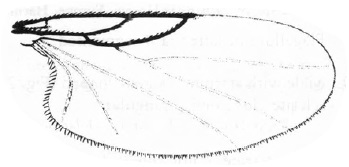
R<sub>4+5</sub> and M fused for a distance, cross-vein R-M obliterated, stem of M fork arising from R<sub>4+5</sub>, well distally from transverse vein (base of R<sub>4+5</sub>)Â [Fig. 753]. Hind tibia flattened, strongly swollen in apical third. A pseudotrachea on labella.
<span class='small'>Four species in Fauna Europaea.</span> |
| Ectaetiinae: Ectaetia Enderlein, 1912 |
|
|
| b |
| Cross-vein R-M present, even if generally very short, often oblique or even horizontal, R<sub>4+5</sub> and M separated, touching at most in one point [Fig. 751] [Fig. 752] and base of M fork arising from just before or below transverse vein (base of R<sub>4+5</sub>). Hind tibia normal, at most slightly enlarged apically. Labella devoid of pseudotrachea. |
|
6 |
| |
|
6a |
| No false vein visible between M2 and CuA<sub>1</sub> [Fig. 751]. Posterior veins and membrane with macrosetae among microtrichia. M fork incomplete, base of M1 lacking [Fig. 751]. Sperm pump of male directly attached to genital capsule. |
| Psectrosciarinae |
|
7 |
| b |
| False vein present as a concave fold between M<sub>2</sub> and CuA<sub>1</sub>, sometimes bifurcated at apex [Fig. 752] (this fold is not always very visible, the wing must be thoroughly observed under different angles of view; usually the fold appears clearly over a dark surface). Posterior veins and membrane with or without macrosetae among the microtrichia. M fork generally complete (except in <i>Thripomorpha</i> with well-visible false vein present). Sperm-pump of male attached to genitalia only by an elongated sperm-duct, lying apparently free in abdomen. |
| Scatopsinae |
|
19 |
| |
|
7a |
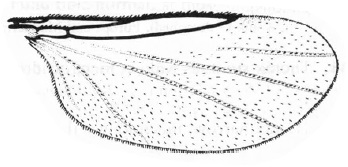
Body strongly compressed laterally, elongated. R<sub>4+5</sub> joining the costa gently in a smooth curve [Fig. 754].
<span class='small'>Two species in Fauna Europaea.</span> |
| Psectrosciara Kieffer in Enderlein, 1911 |
|
|
| b |
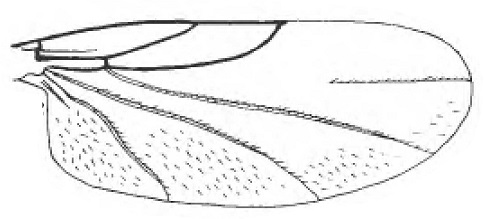
Body not strongly compressed laterally nor elongated. R<sub>4+5</sub> joining rather abruptly the costa, forming with it an angle vicinous to 90 degrees [Fig. 755].
<span class='small'>Twenty four species in Fauna Europaea, one described later from Central Europe by Haenni & Martinovský in 2014.</span> |
| Anapausis Enderlein, 1912 |
|
8 |
| |
|
8a |
| Vein M<sub>1</sub> bent anteriorly at wing margin; macrotrichia on wing membrane anterior to M<sub>1</sub>. Male tergite 8 with two parallel strap-like curved arms, subapically joined by median bridge. Female sternite 7 with broad lateral lobes widely separated medially. |
| Anapausis talpae (Verrall, 1912) |
|
|
| b |
| Vein M<sub>1</sub> not bent anteriorly at wing margin; macrotrichia mainly confined to membrane behind M<sub>1</sub>. Male tergite 8 without apically fused lateral arms. Female sternite 7 not divided into two lobes. |
|
9 |
| |
|
9a |
| First tarsomeres without comb-like rows of stout setae. Male tergite 8 rounded apically with small median indentation, lacking paired processes. Female tergite 8 with small projection medially; tergite 9 absent. |
| Anapausis nigripes (Zetterstedt, 1860) |
|
|
| b |
| First tarsomeres with comb-like rows of spiniform setae. Male tergite 8 with a pair of posteroventrally directed tapered blunt processes. Female tergite 8 without medial projection; tergite 9 well developed. |
|
|
| |
|
10a |
|
11 |
| b |
|
15 |
| |
|
11a |
| Sternite 6 broadly emarginate medially, lateral parts simple and not bilobed. Tergite 8 with pair of processes short, not longer than gap between them [Fig. 315]. |
| Anapausis rectinervis Duda, 1928 |
|
|
| b |
| Sternite 6 deeply emarginate medially, lateral part not simple but variously lobed. |
|
12 |
| |
|
12a |
| Sternite 6 with lateral part not bilobed medially, but with apical margin angled internally and bearing a posteriorly directed thumb-like process near this angle. Tergite 8 with pair of processes about as long or a little longer than gap between them [Fig. 316]. |
| Anapausis pollicata Chandler, 1999 |
|
|
| b |
| Sternite 6 with lateral part deeply bilobed medially. Tergite 8 with pair of processes longer than gap between them. |
|
13 |
| |
|
13a |
| Sternite 6 with narrow emargination, each lateral part with anterior margin evenly curved and posterior lobe pointed apically [Fig. 317]. Stemite 5 with large rounded anterior lobes, broader than the gap between them [Fig. 317]. |
| Anapausis dalmatina Duda, 1928 |
|
|
| b |
| Sternite 6 with wider emargination, each lateral part with anterior margin concave on inner part and posterior lobe not pointed apically. Stemite 5 with rounded anterior lobes small and widely separated. |
|
14 |
| |
|
14a |
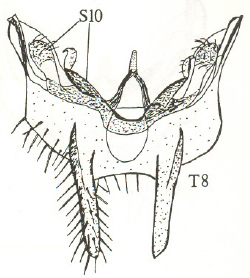
| Sternite 6 with posterior lobes only slightly indented subapically; tergite 8 dark brown, with processes shorter and more slender [Fig. 318]. |
| Anapausis soluta (Loew, 1846) |
|
|
| b |
| Sternite 6 with posterior lobes strongly indented subapically to give a hooked appearance; tergite 8 usually more reddish with processes longer and thicker [Fig. 319]. |
| Anapausis floricola Chandler, 1999 |
|
|
| |
|
15a |
| Tergite 9 distinctly longer than broad, with straight basal margin and deeply inset in tergite 8 which is short medially. Stemite 8 emarginate apically. |
| Anapausis rectinervis Duda, 1928 |
|
|
| b |
| Tergite 9 not longer than broad, with curved basal margin. Tergite 8 broader medially with curved apical margin. |
|
16 |
| |
|
16a |
| Stemite 9 produced apically to a point, protruding beyond tergite 9. Furca with a pair of diverging (ventrally directed) anterior processes [Fig. 757]. |
| Anapausis sp. indet. 1 |
|
|
| b |
| Stemite 9 rounded apically. |
|
17 |
| |
|
17a |
| Tergite 9 more angular and deeply inset in concave apical margin of tergite 8. Furca with single slender anterior process [Fig. 758]. |
| Anapausis dalmatina Duda, 1928 |
|
|
| b |
| Tergite 9 broadly ovate, more shallowly inset in tergite 8Â [Fig. 759]Â [Fig. 760]. |
|
18 |
| |
|
18a |
| Tergite 8 without a rounded lobe laterally. Furca with a pair of short diverging (sometimes anteroventrally directed) anterior processes [Fig. 760]. |
| Anapausis soluta (Loew, 1846) |
|
|
| b |
| Tergite 8 with bluntly rounded lateral lobe (extended more distally than in <i>dalmalina</i>). Furca with single elongate anterior process [Fig. 759]. |
| Anapausis floricola Chandler, 1999 |
|
|
| |
|
19a |
Presence of macrosetae on posterior veins, and also on membrane in some genera [Fig. 763]. Stem of haltere without setae.
<span class='small'>(In minute <i>Parascatopse</i>, at least 12 macrosetae present on CuA<sub>2</sub>, sometimes difficult to see; high magnification necessary).</span> |
| Rhegmoclematini |
|
20 |
| b |
| No macrosetae on posterior veins and on membrane [Fig. 761]. Stem of haltere with setae in Palaearctic genera (except in extra-limital <i>Lumpuria</i> with quadrate scutum, dichoptic eyes in both sexes and elongated hind tibia). |
|
25 |
| |
|
20a |
Presence of macrosetae on M<sub>1</sub>, M<sub>2</sub>, or both. M<sub>1</sub> incomplete basally in Palaearctic species [Fig. 762]. Flagellum of antenna 10-segmented. First abdominal tergite of male often with a granulated ommatidia-like structure.
<span class='small'>Nine species in Fauna Europaea:
<i>bifida</i> (Zilahi-Sebess, 1956) (= <i>collini</i> (Cook, 1969))
<i>cooki</i> (Hutson, 1970)
<i>coxendix</i> (Verrall, 1912)
<i>freyi</i> (Cook, 1969)
<i>haennii</i> Martinovsky, 1996
<i>halteratum</i> (Meigen, 1838)
<i>paludicola</i> Enderlein, 1905 (= <i>edwardsi</i> (Collin, 1954))
<i>verralli</i> (Edwards, 1934)
<i>vockerothi</i> (Cook, 1969)</span> |
| Thripomorpha Enderlein, 1905 |
|
|
| b |
| No macrosetae on M<sub>1</sub> and M<sub>2</sub>, macrosetae present only on CuA<sub>2</sub> vein. M fork complete [Fig. 763]. |
|
21 |
| |
|
21a |
| Flagellum of antenna 10-segmented. |
| Neorhegmoclemina Cook, 1955: Neorhegmoclemina catharinae Haenni, 1997 |
|
|
| b |
| Flagellum of antenna 8-segmented. |
|
22 |
| |
|
22a |
Male with sternite 7 shield-shaped [Fig. 424]. A regular distinct supraalar row of setae. Spiracular sclerite elongated, triangular.
<span class='small'>Four species in Fauna Europaea.</span> |
| Rhegmoclemina Enderlein, 1936 |
|
|
| b |
| Male sternite 7 not shield-shaped. No distinct supraalar row of setae. Spiracular sclerite not elongated, rounded in general shape. Size very small, wing length about 1 mm (mostly coastal or halophilous). |
| Parascatopse Cook, 1955 |
|
23 |
| |
|
23a |
| Legs with tibiae broadly whitish at base, tarsi and halteres pale brown. |
| Parascatopse minutissima (Verrall, 1886) |
|
|
| b |
| Legs uniformly darkish, though not as dark as body. Halteres at least darkened on knob. |
|
24 |
| |
|
24a |
| Sternite 7 broadly triangular. Lateral appendages in the genital capsule wide, rounded apically. |
| Parascatopse litorea (Edwards, 1925) |
|
|
| b |
| Sternite 7 with median posterior projection truncate apically [Fig. 764]. Lateral appendages in the genital capsule narrow, contorted. |
| Parascatopse distorta Haenni & Pollini, 2015 |
|
|
| |
|
25a |
| Thorax stout, as wide as long, quadrate or nearly so. Wings densely microtrichiose. |
| Colobostematini |
|
26 |
| b |
| Thorax narrow, much longer than wide. |
|
32 |
| |
|
26a |
A complete supernumerary cross-vein between M<sub>1</sub> and R<sub>4+5</sub>Â [Fig. 765].
<span class='small'>Four species in Fauna Europaea.</span> |
| Holoplagia Enderlein, 1912 |
|
27 |
| b |
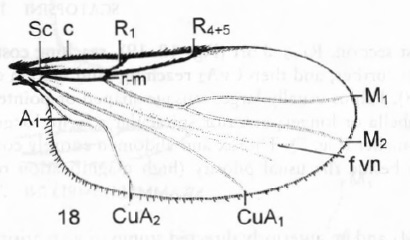
| No complete supernumerary cross-vein between M<sub>1</sub> and R<sub>4+5</sub>Â [Fig. 766], but M<sub>1</sub> often angled at 1/4 basal, sometimes with a stump of vein directed towards R<sub>4+5</sub>Â [Fig. 647]. |
|
31 |
| |
|
27a |
|
|
| b |
|
28 |
| |
|
28a |
| Wing without bulla or microtichose patch between veins M<sub>1</sub> and M<sub>2</sub>. |
|
29 |
| b |
| Wing with bulla or microtichose patch between veins M<sub>1</sub> and M<sub>2</sub>. |
|
30 |
| |
|
29a |
| Wings with CuA<sub>1</sub> slightly bent at apex (compare with [Fig. 641], but not as stong in this figure); M<sub>1</sub> and M<sub>2</sub> parallel and both slightly bent forwards. |
| Holoplagia transversalis (Loew, 1846) |
|
|
| b |
| Wings with CuA<sub>1</sub> straight; M<sub>1</sub> and M<sub>2</sub> not curved basally but parallel and curved forwards along their length, slightly divergent apically. |
| Holoplagia richardsi Freeman, 1985 |
|
|
| |
|
30a |
| Genitalia |
| Holoplagia bullata (Edwards, 1925) |
|
|
| b |
Genitalia
|
| Holoplagia lucifaga (Loew,1870) |
|
|
| |
|
31a |
Flagellar segments with a distinct neck, short, bead-like or conical. Occiput regularly rounded posteriorly. Eyes dichoptic in female, hardly touching and nearly dichoptic in male. Thorax and abdomen dull, not shiny.
<span class='small'>Eleven species keyed by Haenni in 2013 but he mentions at least 18 Western Palaearctic species with probably more undescribed Mediterranean species.</span> |
| Colobostema Enderlein, 1926 |
|
|
| b |
Flagellar segments devoid of neck, cylindrical and more or less elongated. Occiput hollowed out posteriorly, head short. Eyes clearly dichoptic in both sexes. Posterior tibia elongated.
<span class='small'>Not yet recorded in the Palaearctic, 5 Oriental spp., Nepal; Haenni 1988b.</span> |
| Lumpuria Edwards, 1928 |
|
|
| |
|
32a |
Wings infuscate, dull. A cluster of spiniform setae on sternite 7 posteriorly, beside usual setae (visible at high magnification). R<sub>4+5</sub> long, joining costa at about 3/4 of wing length.
<span class='small'>Two species in Fauna Europaea.</span> |
| Ferneiella Cook, 1977 |
|
|
| b |
| Wings clear, more or less hyaline or milky, at most slightly infuscated. No spiniform setae on posterior margin of sternite 7. R<sub>4+5</sub> of variable length. |
|
33 |
| |
|
33a |
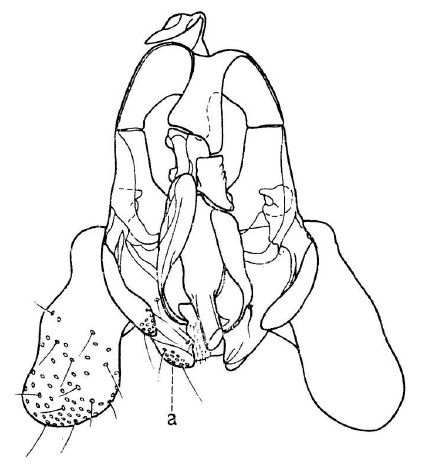
A complete supernumerary cross-vein between M<sub>1</sub> and R<sub>4+5</sub> (though translucent, this vein is
well-visible, especially under tangential light). Vein CuA<sub>2</sub> strongly recurved towards wing base [Fig. 641]. Tarsi white, contrasting with rest of body and legs. |
| Efcookella Haenni, 1998: Efcookella albitarsis (Zetterstedt, 1850) |
|
|
| b |
| No complete supernumerary cross-vein between M<sub>1</sub> and M fork evenly curved or smoothly angled at 1/4 basal, with at most one anteriorly directed stump of vein arising towards R<sub>4+5</sub>. |
|
34 |
| |
|
34a |
| Second costal section practically equal to first section, or longer. R<sub>4+5</sub> long, reaching costa at 2/3 of wing length or further [Fig. 761]; if hardly so (some <i>Reichertella</i>), then CuA<sub>2</sub> smoothly curved towards wing tip [Fig. 761], not reaching abruptly hind margin of wing. Anterior spiracular sclerite nearly as high as long, with a comparatively large spiracular opening [Fig. 767]. Palpus rounded, oval or truncate at apex, usually shorter or approximately as long as labella. |
| Scatopsini |
|
35 |
| b |
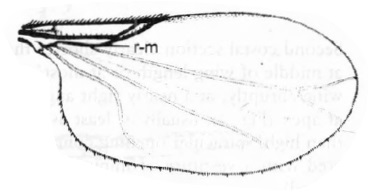
Second costal section clearly shorter than first section. R<sub>4+5</sub> short [Fig. 648] [Fig. 649], reaching costa at middle of wing length or at most somewhat further, and then CuA<sub>2</sub> reaching hind margin of wing abruptly, at a nearly right angle [Fig. 648]. Palpus usually large, sausage shaped or pointed
at apex [Fig. 769], usually at least as long as labella or longer; anterior spiracular sclerite longer than high, spiracular opening comparatively smaller [Fig. 768]. Thorax and abdomen entirely covered with a vestiture of minute microtrichia beside the usual pilosity (high magnification required). |
| Swammerdemellini |
|
41 |
| |
|
35a |
| Fork of M with an angle at 1/4-1/3 basal of M<sub>1</sub> and an anteriorly directed stump of vein arising from this angle (translucent and sometimes weakly visible) [Fig. 647]; if no stump of vein visible (<i>Pharsoreichertella hamifera</i> (Strobl)), then M fork strongly assymetrical, with M<sub>1</sub> strongly bent and M<sub>2</sub> nearly straight [Fig. 770]. |
|
36 |
| b |
| Fork of M practically symmetrical, with M<sub>1</sub> and M<sub>2</sub> evenly and smoothly curved, without any indication of an angle or a stump of vein at 114-113 basal [Fig. 771]. |
|
39 |
| |
|
36a |
Tarsomere 1 of male hind leg shorter than tarsomere 2, or equal in length, armed with spines. Tergite 7 of male not projecting posteriorly, concealed under tergite 6 and weakly sclerotized. M<sub>1</sub> with a well-marked angle at 1/4 basal and a stump of vein directed towards R<sub>4+5</sub>, well-visible though translucent [Fig. 647]. Abdominal tergites and sternites bright, devoid of microtrichia beside the usual pilosity.
<span class='small'>Three species in Fauna Europaea.</span> |
| Scatopse Geoffroy, 1762 |
|
37 |
| b |
Tarsomere 1 of hind leg unmodified in male, longer than tarsomere 2. Tergite 7 of male well-visible and sclerotized, projecting posteriorly in 1 or 2 lobes. Angle of M<sub>1</sub> not very marked, with a weakly visible anteriorly directed stump or, if stump absent, then fork of M strongly asymmetrical [Fig. 770]. Abdominal tergites and sternites dull, at most subshiny, with a vestiture of microtrichia (visible at high magnification) beside the usual pilosity.
<span class='small'>Three species in Fauna Europaea.</span> |
| Pharsoreichertella Cook, 1974 |
|
|
| |
|
37a |
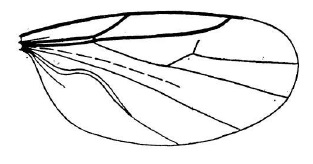
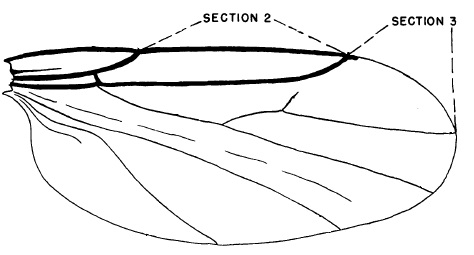
| Entire length of vein R<sub>4+5</sub> ventrally with 3-5 rows of setulae; section 2 of C at least 1.25 times as long as section 3 [Fig. 647]. Male: penis valves apically pointed or nearly so, claw-like [Fig. 644]. Female: sternum 8 with a pair of valvifers [Fig. 646]. |
| Scatopse notata (Linnaeus, 1758) |
|
|
| b |
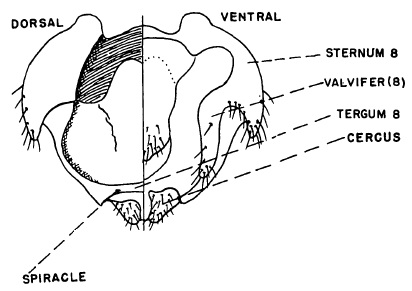
| Vein R<sub>4+5</sub> ventrally with 1-3 rows of setulae, at least on its proximal part; section 2 of C equal to section 3 or shorter [Fig. 645]. Male: penis valves apically broadly rounded. Female: sternum 8 without valvifers. |
|
38 |
| |
|
38a |
Distal third of vein R<sub>4+5</sub> ventrally with 2-3 irregular rows of setulea. Male with first segment of both mid and hind tarsi apically produced, bearing a cluster of spines; gonocoxites broad, rounded, with longest axis nearly transverse to axis of hypopygium; penis short, blunt apically [Fig. 773]. Female with lobes of sternum 8 broad with inner margin straight or nearly so [Fig. 773]; cerci large, proximally largely overlapped by tergum 8 [Fig. 774].
 [Fig. 772] |
| Scatopse globulicauda Laštovka & Haenni, 1981 |
|
|
| b |
| Entire length of vein R<sub>4+5</sub> ventrally with a single row of sotulae. Male with first segment of hind tarsus only produced and bearing spines apically; gonocoxites slender, with axis nearly parallel to axis of hypopygium; penis long, pointed apically. Female with lobes of sternum 8 narrow with inner margin sinuous; cerci small, not proximally overlapped by tergum 8. |
| Scatopse lapponica Duda, 1928 |
|
|
| |
|
39a |
Abdominal sternites (and also tergites) bright, devoid of microtrichia beside the usual pilosity. R<sub>4+5</sub> long, reaching the costa in a smooth curve well beyond 2/3 of wing length [Fig. 771]. Male pregenital segment (sternite and sometimes also tergite 7) diversely modified, with more or less developed, often asymmetrical lateral posterior projections. Penis elongated, filamentous, 2-3 branched, diversely modified at apex; 1-2 pairs of hypogynial valves in female.
<span class='small'>Thirteen species in Fauna Europaea.</span> |
| Apiloscatopse Cook, 1974 |
|
|
| b |
Abdominal sternites dull or at most subshiny, with a vestiture of microtrichia (visible at high magnification) beside the usual pilosity. R<sub>4+5</sub> shorter, reaching the costa at about 2/3 of wing length, or if longer (<i>Reichertella geniculata</i>), then running parallel to the costa and joining this vein after a marked knee. Male tergite 7 partly desclerotized or reduced, much shorter than sternite 7. Penis shorter and thick, more or less contorted, enlarged or flattened. No hypogynial valves in female.
<span class='small'>Three species in Fauna Europaea.</span> |
| Reichertella Enderlein, 1912 |
|
40 |
| |
|
40a |
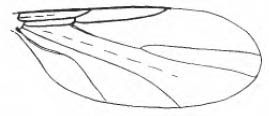
| Vein R<sub>4+5</sub> parallel to costa for most of its length, fairly sharply turned towards costa at its end [Fig. 434], |
| Reichertella geniculata (Zetterstedt, 1850) |
|
|
| b |
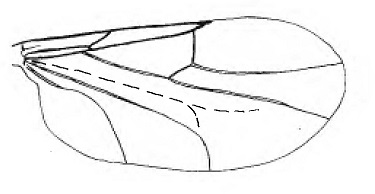
| Vein R<sub>4+5</sub> more or less converging gradually on to costa, not sharply turned towards it apically, costa shorter, anal angle more obtuse [Fig. 435]. |
| other Reichertella sp. |
|
|
| |
|
41a |
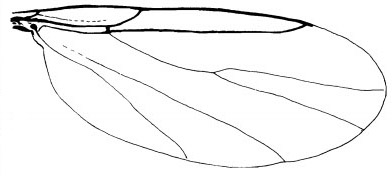
M fork short or very short, always shorter than M stem [Fig. 415]. R<sub>1</sub> and R<sub>4+5</sub> joining costa very close to each other; distance between them (second costal section) shorter than length of R<sub>1</sub> from origin of R<sub>4+5</sub> to costa [Fig. 415]. Palpus pointed apically [Fig. 769].
<span class='small'>Six species in Fauna Europaea, one species described later by Haenni from Spain in 2015.</span> |
| Swammerdamella Enderlein, 1912 |
|
42 |
| b |
| M fork obviously longer than stem [Fig. 648]. |
|
43 |
| |
|
42a |
Flagellum 8-segmented. M-fork longer, branches almost as long as or longer than stem.
<i>Swammerdamella pediculata</i> (Duda, 1928), <i>Swammerdamella genypodis</i> Cook, 1972, <i>Swammerdamella spinigera</i> Haenni, 2009 |
|
|
| b |
Flagellum 7-segmented. M-fork very short, branches much shorter than stem.
<span class='small'><i>Swammerdamella acuta</i> Cook, 1956: Thorax relatively narrow; anterior spiracle below the midline of the spiracular plate; male tergite 6 with angular posterior margin.
<i>Swammerdamella adercotris</i> Cook, 1972: Thorax relatively broad; anterior spiracle on the midline of the spiracular plate; male tergite 6 shorter with more blunt, bar-like projection on posterior margin
<i>Swammerdamella brevicornis</i> (Meigen, 1830): Male tergite 6 longer with angular distinctly more produced, pointed
[i]Swammerdammella jindrichi Haenni in Haenni & RoháÄek, 2020</span> |
|
|
| |
|
43a |
| Anterior spiracular sclerite a large, rather quadrate plate, twice as long as high. Male tergite 7 asymmetrically produced posteriorly as a narrow spatulate process. Aedeagus elongated, coiled. Female sternite 8 with a pair of conspicuous, fingerlike lobes projecting posteriorly. Sternites 2 and 3 sclerotized. |
| Coboldia Melander, 1916: Coboldia fuscipes (Meigen, 1830) |
|
|
| b |
| Anterior spiracular sclerite triangular elongated [Fig. 768]. Male tergite 7 symmetrical, either narrowly produced medially or not posteriorly. |
|
44 |
| |
|
44a |
Male terminalia dorsoventrally compressed. Female tergite 8 and sternite 8 without deep medial incision.
<span class='small'>Nine species in Fauna Europaea.</span> |
| Rhexoza Enderlein, 1936 |
|
|
| b |
| Male terminalia laterally compressed. |
|
45 |
| |
|
45a |
| Sternite 4 produced. Tergite 9 produced ventrally as a beak–like process. Posterior extension of aedeagus (“aedeagal plateâ€) cylindrical; parameres large basally. Female tergite 8 medially divided, sternite 8 not. |
| Quateiella Cook, 1975: Quateiella inexpectata Haenni, 1988 |
|
|
| b |
| Sternite 4 not produced. Tergite 9 without beak–like ventral extension. Aedeagal plate rather flattened; sperm duct opening on extension of aedeagus; gonostylus absent; base of parameres displaced distally. Female with tergite 8 deeply incised medially, sternite 8 broadly divided in two basally broad, apically pointed lateral lobes. |
| Cooka Amorim, 2007: Cooka incisa (Cook, 1956) |
|
|
| |
| Images |
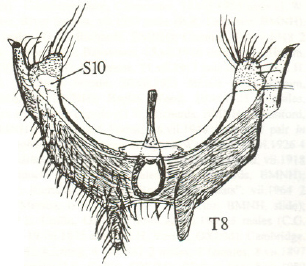 |
| Figure 315. Anapausis rectinervis, male tergite 8 and sternite 10 (after Chandler, 1999). |
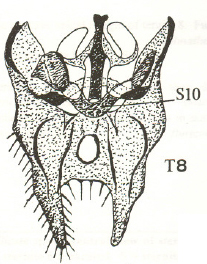 |
| Figure 316. Anapausis pollicata, male tergite 8 and sternite 10 (after Chandler, 1999). |
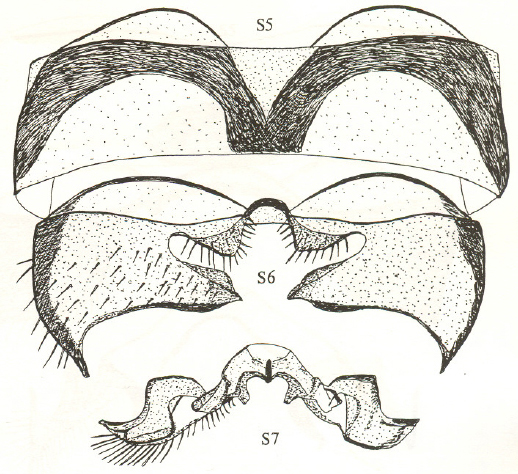 |
| Figure 317. Anapausis dalmatina, male sternites 5-7 (after Chandler, 1999). |
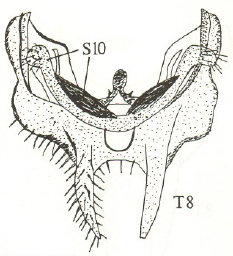 |
| Figure 318. Anapausis soluta, male tergite 8 and sternite 10 (after Chandler, 1999). |
 |
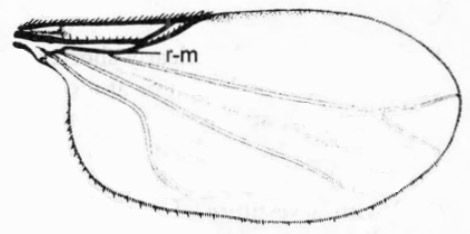
| Figure 319. Anapausis floricola, male tergite 8 and sternite 10 (after Chandler, 1999). |
 |
| Figure 415. Swammerdamella obtusa, wing (after Haenni, 1997). |
 |
| Figure 416. Apiloscatopse subgracilis, male wing (after Haenni & Greve, 1995). |
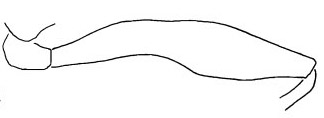 |
| Figure 417. Apiloscatopse subgracilis, male left hind femur (after Haenni & Greve, 1995). |
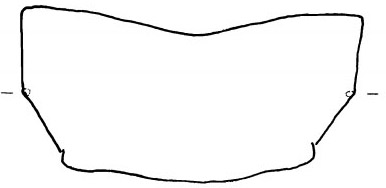 |
| Figure 418. Apiloscatopse subgracilis, male tergite 7 (after Haenni & Greve, 1995). |
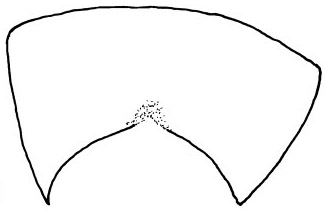 |
| Figure 419. Apiloscatopse subgracilis, male sternite 7 (after Haenni & Greve, 1995). |
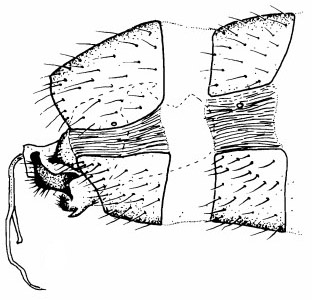 |
| Figure 420. Apiloscatopse subgracilis, male genitalia in lateral view (after Haenni & Greve, 1995). |
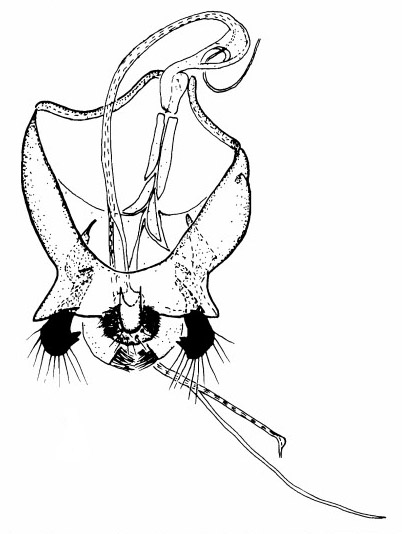 |
| Figure 421. Apiloscatopse subgracilis, male genital capsule in dorsal view (after Haenni & Greve, 1995). |
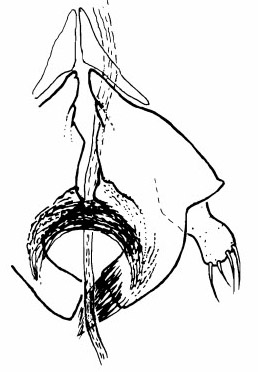 |
| Figure 422. Apiloscatopse subgracilis, male penis valves in ventral view (after Haenni & Greve, 1995). |
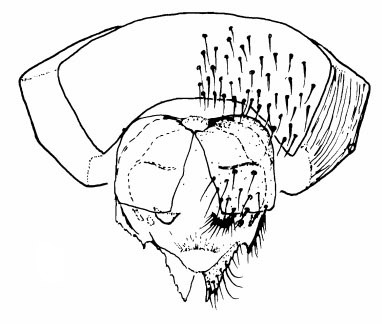 |
| Figure 423. Apiloscatopse subgracilis, female genitalia in ventral view (after Haenni & Greve, 1995). |
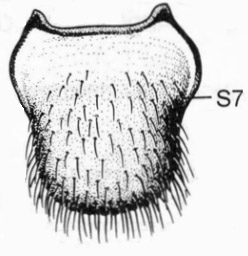 |
| Figure 424. Rhegmoclemina bimaculata, male, sternite 7 in ventral view (after Haenni, 1997). |
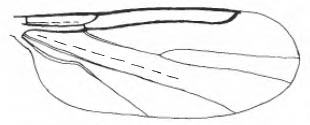 |
| Figure 434. Reichertella geniculata, wing (after Freeman, 1985). |
 |
| Figure 435. Reichertella pulicaria, wing (after Freeman, 1985). |
 |
| Figure 641. Efcookella albitarsis, wing |
 |
| Figure 644. Scatopse notata, male genital capsule in dorsal view |
 |
| Figure 645. Scatopse globulicauda, wing |
 |
| Figure 646. Scatopse notata, female genitalia |
 |
| Figure 647. Scatopse notata, wing |
 |
| Figure 648. Coboldia fuscipes, wing |
 |
| Figure 649. Swammerdamella obtusa, wing |
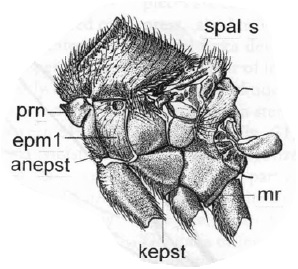 |
| Figure 749. Aspistes sp., thorax in lateral view |
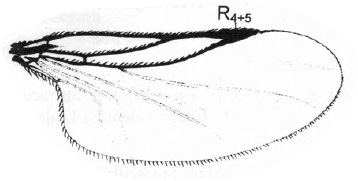 |
| Figure 750. Aspistes sp., wing |
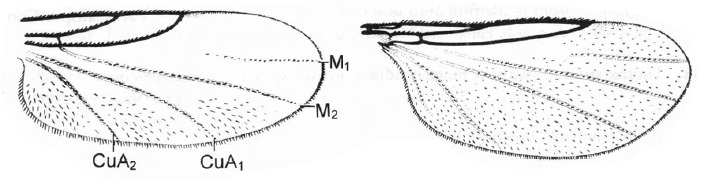 |
| Figure 751. Psectrosciarinae, wings |
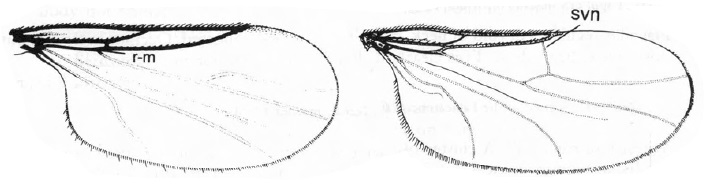 |
| Figure 752. Scatopsinae, wings |
 |
| Figure 753. Ectaetia sp., wing |
 |
| Figure 754. Psectrosciara sp., wing |
 |
| Figure 755. Anapausis soluta, wing |
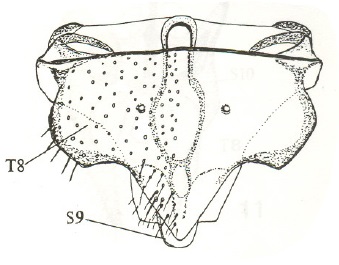 |
| Figure 756. Anapausis sp. Austria, female genitalia in dorsal view |
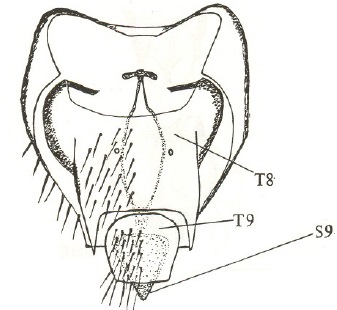 |
| Figure 757. Anapausis sp. Scotland, female genitalia in dorsal view |
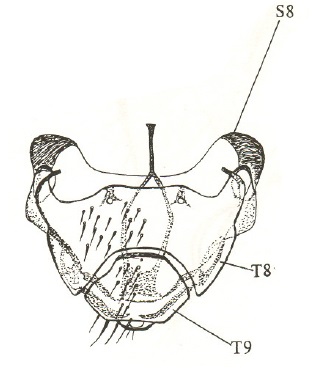 |
| Figure 758. Anapausis dalmatina, female genitalia in dorsal view |
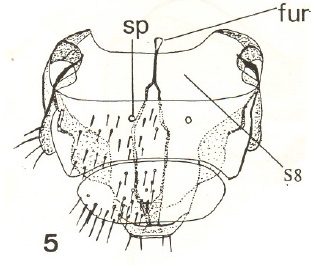 |
| Figure 759. Anapausis floricola, female genitalia in dorsal view |
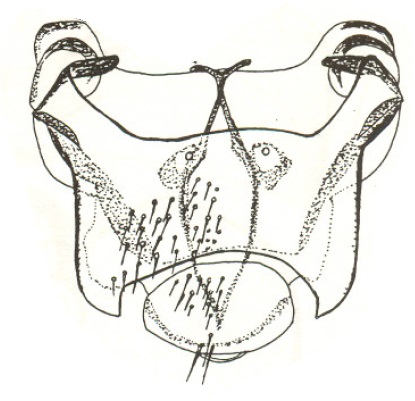 |
| Figure 760. Anapausis soluta, female genitalia in dorsal view |
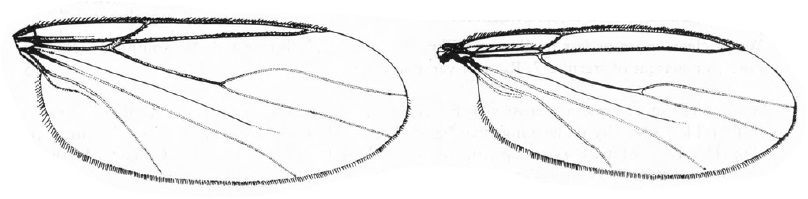 |
| Figure 761. Scatopsinae, wings |
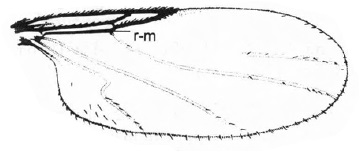 |
| Figure 762. Thripomorpha sp., wing |
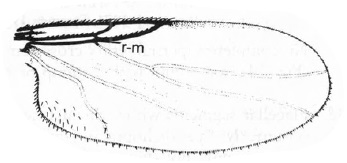 |
| Figure 763. Rhegmoclemina sp., wing |
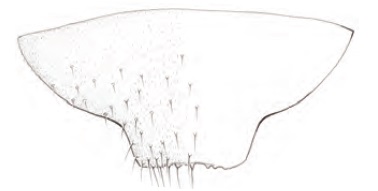 |
| Figure 764. Parascatopse distorta, male sternite 7 |
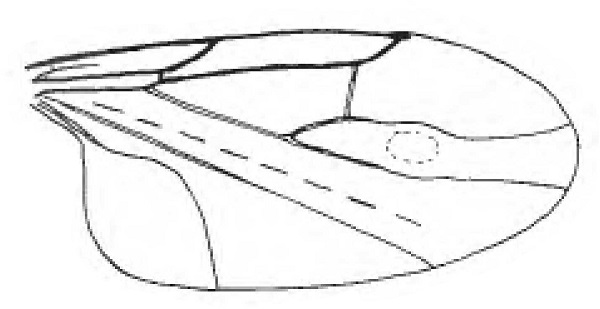 |
| Figure 765. Holoplagia bullata, female wing |
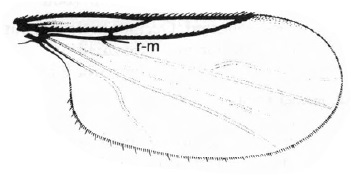 |
| Figure 766. Colobostema variatum, wing |
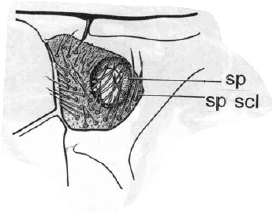 |
| Figure 767. Scatopse notata, anterior spiracle |
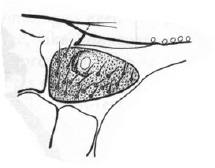 |
| Figure 768. Rhexoza incisa, anterior spiracle |
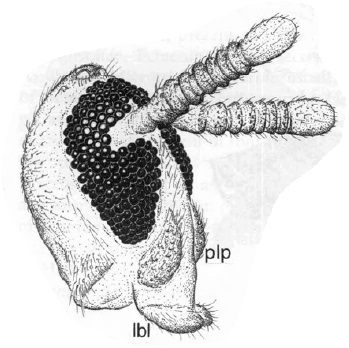 |
| Figure 769. Swammerdemella acuta, head in lateral lateral view |
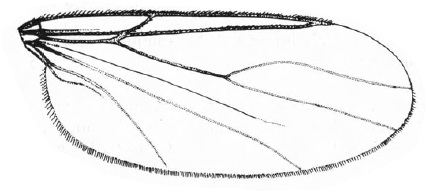 |
| Figure 770. Pharsoreichertella hamifera, wing |
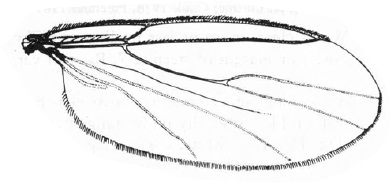 |
| Figure 771. Apiloscatopse filamentosa, wing |
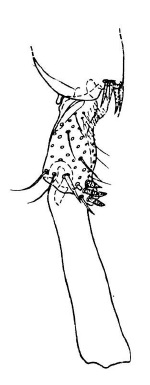 |
| Figure 772. Scatopse globulicauda, basal segments of male hind tarsus |
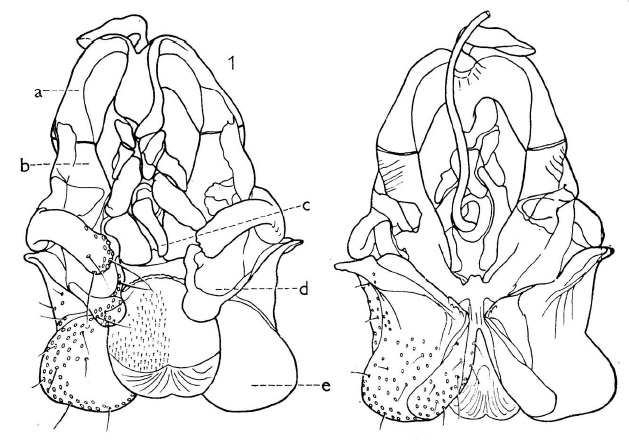 |
| Figure 773. Scatopse globulicauda, male genitalia |
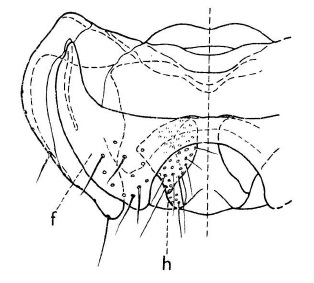 |
| Figure 774. Scatopse globulicauda, female genitalia in dorsal view |
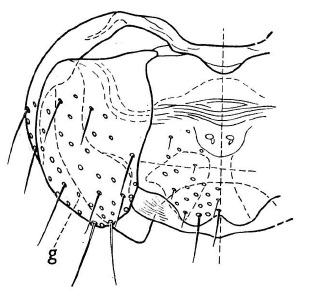 |
| Figure 775. Scatopse globulicauda, female genitalia in ventral view |